How AI Is Transforming Recruitment in 2026
https://youtu.be/wYMJXOiGJTo
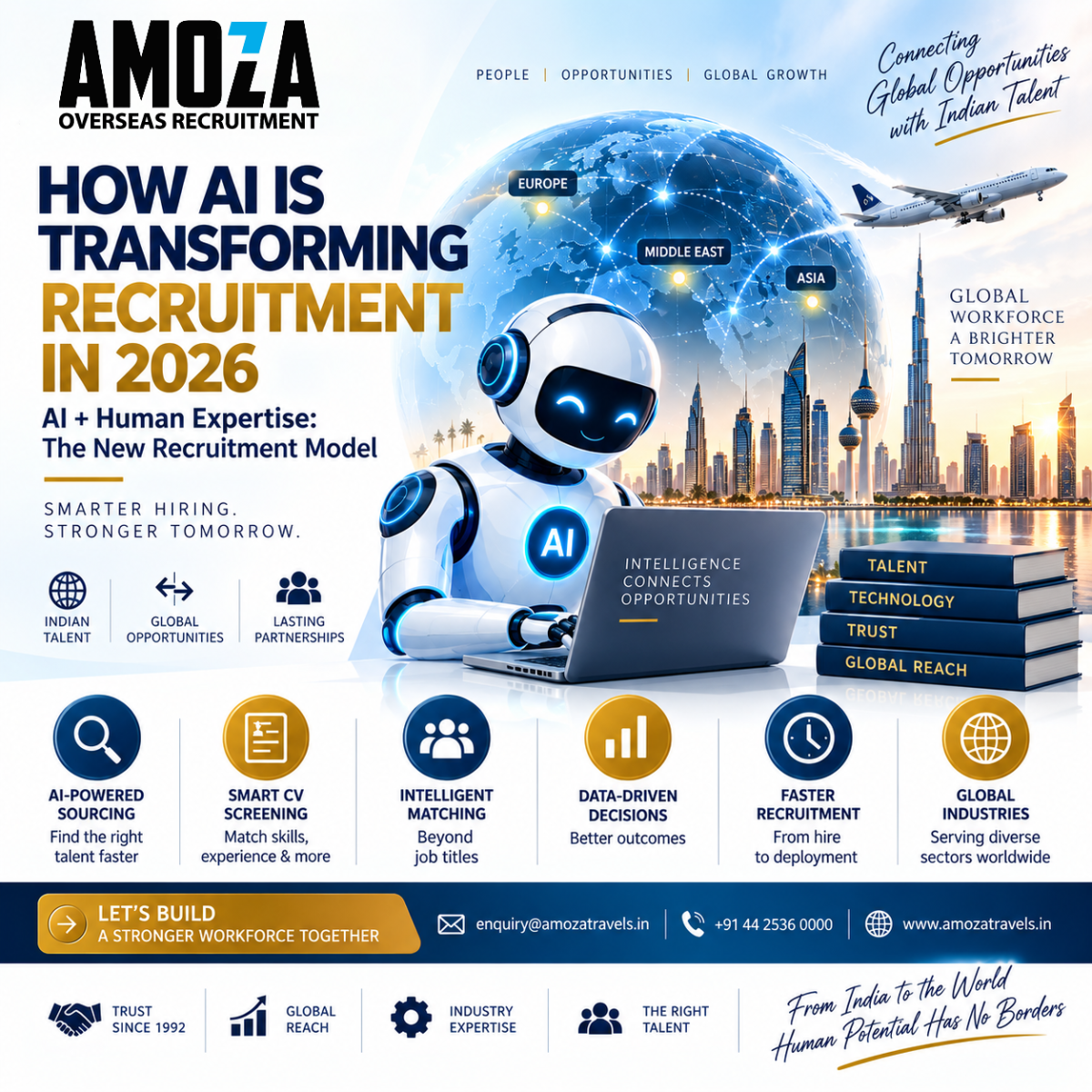
How AI Is Transforming Recruitment in 2026
From Candidate Sourcing to Global Talent Deployment
The recruitment industry is entering a new phase of digital transformation. Artificial Intelligence (AI) is increasingly helping recruitment professionals discover candidates, screen applications, identify relevant talent, analyse recruitment data and accelerate hiring workflows.
For international recruitment, where employers may require large numbers of qualified professionals within demanding project timelines, the ability to process information quickly and systematically can make a significant difference.
However, the future of recruitment is not about replacing recruiters with AI. It is about combining technology, data and human expertise to create a faster, more structured and more effective recruitment process.
1. AI-Powered Candidate Sourcing
Traditional recruitment often begins with searching through multiple talent sources, including:
-
CV databases
-
Job portals
-
Professional networks
-
Recruitment databases
-
Previous applicants
-
Employee referrals
-
Social platforms
-
Recruitment campaigns
AI can help recruitment teams analyse these sources and identify candidates based on a broader combination of skills, experience, qualifications, job titles and other relevant criteria.
This represents an important shift from simply searching for an exact job title to identifying people whose overall capabilities may correspond with the requirements of a position.
From Keyword Search to Skills Discovery
For example, a candidate may not have the exact job title specified by an employer but may possess related technical skills, project experience and industry knowledge.
AI-assisted sourcing can help recruiters identify these connections and bring potentially relevant candidates into the review process.
2. Faster CV Screening
High-volume recruitment can create a significant workload for recruitment teams.
Consider an international recruitment campaign involving 3,000 applications for 200 positions. Manually reviewing every CV against multiple requirements can require substantial time.
AI-assisted screening can analyse resumes against defined criteria and organise candidates for human review.
Potential screening criteria can include:
-
Qualifications
-
Years of experience
-
Technical skills
-
Industry experience
-
Certifications
-
Previous employers
-
Project experience
-
Location
-
Language skills
-
Job-specific requirements
The objective is not to allow AI to make the final hiring decision. Instead, AI can help recruiters move more quickly from a large applicant pool toward a focused group of candidates requiring detailed human evaluation.
3. Intelligent Talent Matching
One of the most significant opportunities presented by AI is intelligent candidate-to-job matching.
Traditional recruitment searches can depend heavily on keywords and exact job titles. AI-assisted matching can look at relationships between different elements of a candidate's profile and the employer's requirements.
Candidate Profile
AI can analyse factors such as:
-
Skills
-
Experience
-
Qualifications
-
Certifications
-
Career context
-
Industry background
Job Requirements
These can be compared with:
-
Role-specific skills
-
Experience level
-
Industry requirements
-
Project requirements
-
Location and language requirements
-
Job-specific criteria
The result can be a broader, more context-aware candidate pool for recruiters to evaluate.
4. Recruitment Is Becoming More Data-Driven
Recruiter experience remains an important part of successful recruitment. AI does not eliminate that expertise; instead, it can expand the recruitment team's ability to analyse data.
Recruitment teams can increasingly examine:
Source Performance
Which recruitment channels are producing relevant candidates?
Conversion Rates
How many candidates progress from application to interview and eventually to hiring?
Quality of Hire
Do selected candidates meet the requirements of the role?
Decision Support
What patterns within recruitment data can help improve future processes?
This creates an opportunity to move from recruitment decisions based primarily on isolated observations toward decisions supported by broader process and outcome data.
The underlying principle remains important:
Data can support recruiter judgment, but human accountability remains essential.
5. AI Can Improve Recruitment Speed
Speed is particularly important in international recruitment.
Employers managing construction projects, facility management operations, engineering projects, hospitality operations and other large-scale activities may have urgent manpower requirements.
AI-assisted recruitment can help accelerate several stages of the process.
Shorter Time-to-Hire
Large applicant pools can be organised into more focused groups for recruiter review.
Faster Access to Qualified Talent
AI-supported sourcing can help recruitment teams identify potentially relevant candidates more quickly.
Faster Project Mobilisation
Streamlined recruitment workflows can support international employers working against project deadlines.
Better Candidate Engagement
Reducing unnecessary processing delays can improve visibility and communication throughout the recruitment process.
AI therefore has the potential to support recruitment teams where speed, scale and structured processing are particularly important.
6. The Future Recruitment Workflow
The future of recruitment is likely to involve a connected workflow in which AI handles repetitive analysis while experienced professionals remain involved at important decision points.
A typical AI-enabled international recruitment workflow can include:
01 — Employer Requirement
Understanding the employer's manpower needs.
02 — AI-Assisted Job Analysis
Structuring the requirements and identifying relevant criteria.
03 — Candidate Sourcing
Searching multiple candidate channels.
04 — AI CV Screening
Organising applications according to defined requirements.
05 — Talent Matching
Identifying relationships between candidate capabilities and job requirements.
06 — Recruiter Validation
Human professionals review and validate shortlisted candidates.
07 — Interview
Candidates participate in the appropriate interview process.
08 — Technical / Skill Assessment
Relevant technical capabilities are assessed.
09 — Employer Interview
The employer evaluates shortlisted candidates.
10 — Document Verification
Required documents and credentials are reviewed.
11 — Medical & Compliance
Necessary medical and compliance procedures are completed.
12 — Visa Processing
Required immigration and visa processes are handled.
13 — Deployment
The selected candidate proceeds toward international employment.
This is a human-in-the-loop model. Technology supports the workflow, while recruiters, assessors, employers and compliance teams remain involved at critical stages.
What Does AI Mean for the Future of Recruitment?
AI is changing recruitment across several important areas:
SOURCE — Broader candidate discovery using skills, experience and contextual signals.
SCREEN — Faster organisation of high-volume applications for human review.
MATCH — More intelligent relationships between candidate capabilities and job requirements.
MEASURE — Greater use of recruitment process and outcome data.
ACCELERATE — Reduced processing time for urgent international recruitment requirements.
HUMAN CONTROL — Final decisions, validation, interviews, compliance and deployment remain people-led.
AI + Human Expertise: The Next Generation of Recruitment
The future of recruitment is not simply about adopting new technology. It is about using technology responsibly to strengthen the capabilities of recruitment professionals.
AI can process large volumes of information, identify patterns and support faster workflows. Recruiters bring experience, professional judgment, candidate understanding, employer relationships and accountability.
Together, these capabilities can create a recruitment model designed for greater speed, scale and insight.
For international employers, this transformation can help recruitment teams manage increasingly complex talent requirements while maintaining human involvement throughout critical stages of the hiring process.
The Future Is Human + AI
AI is transforming how recruitment teams discover, screen, match, analyse and move talent.
But technology is most valuable when it works alongside people.
The future is not AI replacing recruitment professionals — it is AI helping professionals work with greater speed, scale and insight.
About AMOZA Overseas Recruitment
AMOZA Overseas Recruitment supports international employers in connecting with skilled Indian talent across global employment markets.
With recruitment expertise combined with evolving technology-enabled processes, the focus remains on helping employers identify, evaluate and mobilise suitable talent for their workforce requirements.
Looking for skilled professionals from India? Connect with AMOZA Overseas Recruitment to discuss your international manpower requirements.