
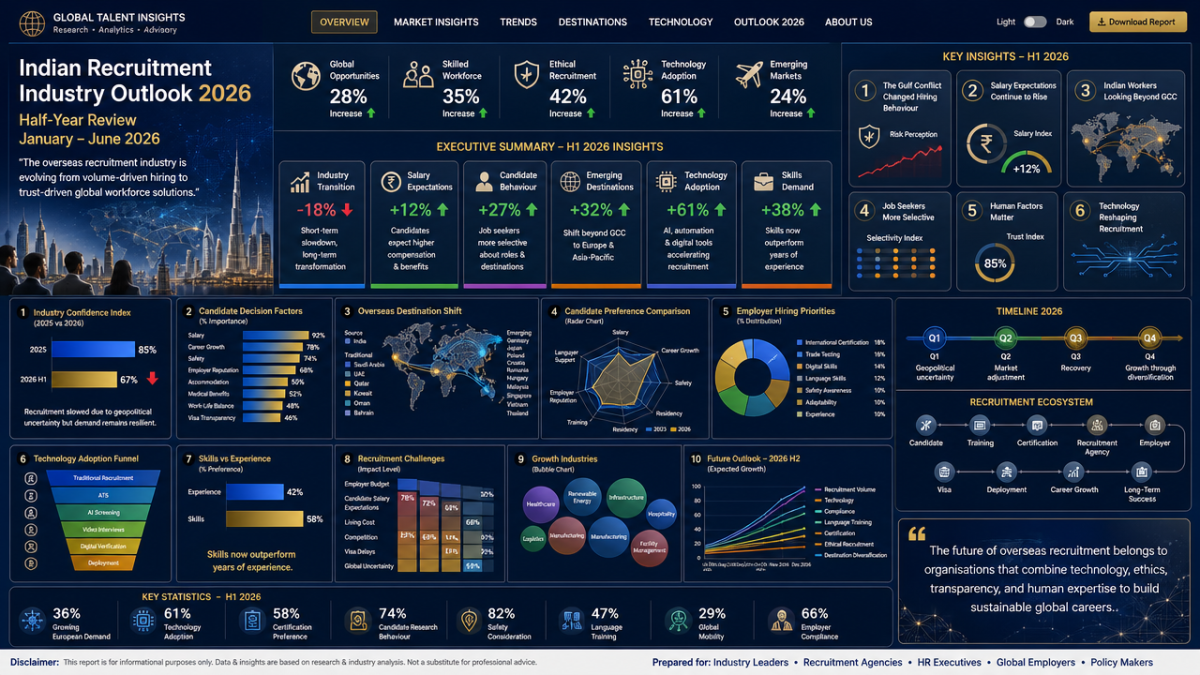
Indian Recruitment Industry Outlook 2026: Half-Year Review
Indian Recruitment Industry Outlook 2026: Half-Year Review
A Market in Transition, Not in Decline
The first half of 2026 has been one of the most challenging and transformative periods for the overseas recruitment industry. Global geopolitical tensions, changing workforce expectations, salary pressures, and shifting migration trends have reshaped how employers recruit and how Indian professionals choose overseas careers.
For Indian recruitment agencies, success is no longer measured by the number of deployments alone. It is increasingly determined by the ability to understand global labour market changes and respond with speed, transparency, and value.
1. The Gulf Conflict Has Changed Hiring Behaviour
The geopolitical tensions in the Gulf region created uncertainty among both employers and job seekers. While major infrastructure and energy projects largely continued, many companies delayed recruitment decisions until market conditions became clearer.
Indian workers also became more cautious. Safety, political stability, and long-term employment security are now part of the decision-making process before accepting overseas offers.
Recruitment agencies have therefore shifted from simply filling vacancies to educating candidates about destination risks, employer stability, and contract security.
2. Salary Expectations Continue to Rise
One of the biggest challenges across the GCC has been the widening gap between employer budgets and candidate expectations.
Many employers continue to offer salary packages based on pre-pandemic market conditions, while candidates compare these offers with increasing living costs, inflation, and better opportunities elsewhere.
Today's job seekers evaluate:
- Net savings after accommodation and food
- Overtime availability
- Medical insurance
- Annual leave benefits
- Career growth
- Family status and quality of life
Candidates are no longer choosing jobs based solely on tax-free salaries.
3. Indian Workers Are Looking Beyond the GCC
For decades, the Gulf Cooperation Council remained the primary destination for Indian overseas workers.
However, 2026 has shown a noticeable shift.
Countries such as Germany, Japan, Poland, Croatia, Hungary, Romania and several Southeast Asian nations are attracting increasing interest from skilled Indian workers due to better career progression, structured immigration pathways, and long-term residency opportunities.
Language training, technical certification, and government-supported migration programmes have further accelerated this trend.
The GCC remains an important destination, but it now competes with new global opportunities rather than dominating the overseas employment market.
4. Job Seekers Have Become More Selective
Today's candidates are significantly more informed than they were just a few years ago.
Before accepting an offer, many candidates research:
- Employer reputation
- Accommodation standards
- Working hours
- Employee reviews
- Promotion opportunities
- Visa transparency
- Recruitment agency credibility
Social media, YouTube, and messaging platforms have made overseas recruitment highly transparent.
Candidates are increasingly willing to reject offers that do not meet their personal or financial expectations.
5. Human Factors Matter More Than Ever
Recruitment is no longer just about matching a CV with a vacancy.
Today's successful recruiter understands the human side of migration.
Candidates ask questions such as:
- Will this job improve my family's future?
- Is the country safe?
- Can I build a long-term career?
- Will my employer respect my rights?
- Is there an opportunity for permanent settlement?
Understanding these emotional and personal motivations has become just as important as evaluating technical skills.
6. Skills Are Replacing Experience
Employers are becoming increasingly selective.
Instead of simply requesting years of experience, they now prioritise:
- International certifications
- Trade testing
- Language proficiency
- Digital literacy
- Adaptability
- Safety awareness
Workers who continuously upgrade their skills enjoy better salaries and faster placements than those relying solely on years of experience.
7. Technology Is Reshaping Recruitment
Artificial intelligence, applicant tracking systems, online interviews, digital document verification, and skill assessment platforms are transforming recruitment operations.
However, technology cannot replace the trust required in international recruitment.
Employers still value agencies that can verify candidates, assess attitudes, ensure compliance, and support successful deployment.
The future belongs to agencies that combine technology with human expertise.
Outlook for the Second Half of 2026
The overseas recruitment market is expected to remain active, but competition will intensify.
Key trends likely to shape the remainder of the year include:
- Continued demand for skilled technical manpower.
- Growth in healthcare, renewable energy, logistics, manufacturing, hospitality, and infrastructure sectors.
- Increased emphasis on language training and certification.
- Greater candidate focus on safety, career growth, and quality of life.
- More diversified migration beyond traditional Gulf destinations.
- Stronger demand for ethical, transparent, and compliant recruitment practices.
Final Thoughts
The Indian overseas recruitment industry is entering a new era.
Employers can no longer rely solely on attractive salaries, and recruitment agencies can no longer depend only on large candidate databases.
Success in 2026 belongs to organisations that understand changing global labour markets, invest in candidate development, embrace technology, and maintain the highest standards of ethical recruitment.
The future of international recruitment will not be defined by volume alone—but by trust, quality, adaptability, and long-term partnerships between employers, recruiters, and skilled professionals.